

Review: Looot
Introduction & Overview
The moment they caught sight of your longships’ banners flying proudly on the horizon, the inhabitants of this wealthy land courageously fled! Seize the diverse goods they left behind and plunder the virtually defenseless buildings so you can be crowned the next Viking Jarl!

This is the premise behind Looot, designed by Charles Chevallier (Abyss, Kanagawa) and Laurent Escoffier (Loony Quest, Doodle Quest). First published in 2024 by Gigamic in English and French editions. Illustrations are handled by Xavier Gueniffey Durin, better known as Naïade, the artist behind titles such as Seasons and Tokaido.
It has not been published in Spanish, so you will need to turn to imports or the secondary market (the game is completely language-independent). It supports 2 to 4 players, with a suggested minimum age of 10 and an approximate playing time of 35 minutes. The retail price is €34.95. For this review, a review copy of Gigamic’s French edition was used.

Important: if you already know the game and/or are only interested in my opinion about it, you can go directly to the Opinion section. The Content and Mechanics sections are especially intended for those who do not know the game and prefer to get a general idea of how it works.
Components
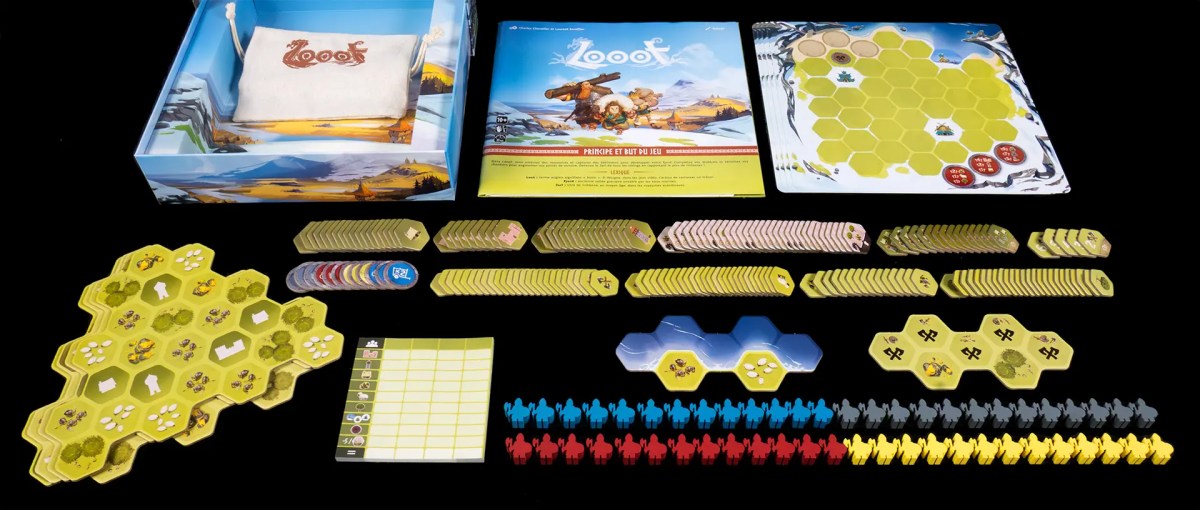
Inside a two-piece cardboard box (lid and base), measuring 26×26×6 cm (a square box of similar dimensions to other Gigamic titles like Block Ness or The Hanging Gardens), we find the following items:
- 4 Terrain Boards (cardboard)
- Ocean Board (cardboard)
- Trophy Board (cardboard)
- 43 Building Tokens (cardboard):
- 18 Houses
- 16 Watchtowers
- 9 Castles
- 15 Construction Site Tiles (cardboard):
- 5 Harbors
- 5 Altars
- 5 Palaces
- 5 Trophy Tiles (cardboard)
- 90 Resource Tiles (cardboard)
- 30 Longship Tiles (cardboard)
- 4 Fjord Boards (cardstock)
- 12 Shield Tokens (3 in each color)
- 52 Vikings (13 in each color)
- Cloth Bag
- Scorepad (paper)
- Rulebook
How to Play
Looot is a game where players manage a hexagonal player board, three spaces of which are initially occupied by three objectives that require specific tile types placed on adjacent spaces to score points. In addition, there is a shared central board assembled from several pieces displaying hexagonal spaces with various resource types (sheep, wood, axes, and gold), along with spaces containing buildings (houses, watchtowers, and castles). On each turn, the active player must place a meeple from their supply onto an unoccupied space adjacent to the sea or adjacent to any other meeple, claiming the element shown on that space to place it on any empty space of their personal board. Afterward, if the player meets the requirements to claim one or more structures, they also take them from the main board and place them on their personal board. The player may also draft a longship tile, which depicts an adjacency requirement to be activated and will increase the scoring value of a specific element added to their board. Finally, if the player has accumulated enough axes, they may claim a trophy tile (though each player may only claim one among the available options). Each participant also has three special abilities that can be triggered once per game (taking another turn, placing on an occupied space, or gaining two tiles of the resource type on the occupied space). The game ends once all players have placed all their meeples.
Key Concepts
Let us begin with the Terrain Boards. These are modular triangular pieces made up of hexagonal spaces. Each game connects as many pieces as there are players to form the main board. Each space on these tiles shows either a resource type (Wood, Sheep, Gold, or Axes) or a building type (Houses, Watchtowers, and Castles). Attached to these modular boards are the Trophy Board (where trophies are placed) and the Ocean Board (where longships are displayed).

The core element of the game is the Vikings. Each player has a set of these meeples to deploy onto the main board. Placing one of these meeples on a space grants the player a resource tile. The requirements for placing a Viking are that the space must be empty (a restriction that can be bypassed using a shield token) and adjacent to either the ocean or a space already occupied by at least one other Viking, regardless of color. Furthermore, these Vikings determine the length of the game, which concludes once all players have placed all their meeples.

Placing a Viking on a resource space earns the player a Resource Tile. These are hexagonal tiles depicting Axes, Wood, Sheep, and Gold.

Next are the Building Tiles, obtained by forming specific patterns on the main board. Houses are claimed by placing a Viking adjacent to their space. Watchtowers are collected by connecting two watchtower spaces with an unbroken line of your own Vikings (taking one watchtower from each space if available). Castles are secured by connecting groups of four Vikings to their space (a single player can collect multiple castles from the same space by connecting multiple distinct groups, whether directly or as part of an extended group of 8 or 12 Vikings).

The third type of tile available to players is the Longship Tiles, representing Viking vessels, with one side displaying three required Resources and a bonus for a specific resource or building type. When a player successfully surrounds a longship with the required resources, they flip it over to increase the value of the designated element shown on the reverse side. On each turn, the active player may take one of these tiles; however, caution is advised, as any incomplete longship incurs a penalty at the end of the game.

These building and resource tiles are placed on the Fjord Boards. These individual player boards feature a grid of hexagonal spaces to accommodate resources, buildings, and longships. They also feature three designated spaces for Construction Sites, one for a trophy tile, and three spaces for shield tokens. The bottom-right corner displays the base victory points provided by each element added to the board (resources and buildings).

The Construction Sites are tiles placed on designated spaces on each player’s board. One side displays the Resources and Buildings required to complete the site, while the other shows a completed illustration, allowing it to score at the end of the game depending on the type of site.

Players also compete to claim Trophy Tiles. Each of these tiles requires a minimum threshold of axes collected on the player’s fjord board before it can be taken. The victory points awarded increase according to the difficulty of the requirement. Moreover, each participant can only claim a single trophy during the game.

Finally, there are the Shield Tokens, which trigger a one-time special ability when used. Each can be activated once per game, and multiple shields may be spent on the same turn.

That is enough to get started.
Preparación de la Partida
- Take as many Landscape tiles as there are players and assemble them to form the game board, aligning matching edges.
- Place 2 Houses, 2 Watchtowers, and 3 Castles on their corresponding spaces on the board.
- Attach the Trophy board to one edge of the game board and arrange the 5 Trophies on it in ascending order.
- Attach the Ocean board to another edge of the game board. Place all 30 Longships into the bag, mix them, draw 5, and place them face up on the Ocean board spaces with their Longship side visible.
- Form a supply next to the board with all Resource tiles (Axes, Wood, Sheep, and Gold).
- Each player chooses a color and receives:
- A Fjord Board
- 13 Vikings
- 3 Shield Tokens, placed on their designated spaces on the Fjord board.
- Shuffle the Construction tiles separately by type (Harbors, Altars, and Jarl Palaces) and deal one random tile of each type to every player. These are placed on the corresponding spaces of their Fjord board, with the requirement side visible.
- Randomly select the starting player.
We are ready to begin!

Game Flow
A game of Looot unfolds over an indeterminate number of alternating turns, beginning with the starting player and proceeding clockwise.
On their turn, the active player proceeds as follows:
- Place a Viking (mandatory). The player places a Viking on an unoccupied Resource space adjacent to another Viking (of any color) or to a Longship space at sea. They collect the matching Resource tile and place it on an empty space of their Fjord board.
- Capture a Building (conditional). If the player meets the capture condition for Houses (placing a Viking adjacent to the house), Watchtowers (connecting two watchtower spaces with an unbroken line of their own Vikings, claiming one from each space), or Castles (connecting a group of 4 Vikings to a castle space, with the option to claim a second or third castle by connecting a new group or expanding an existing one to 8 or 12). Captured buildings are placed on empty spaces of their Fjord board.
- Complete a Construction Site (conditional). If the Resources and Buildings placed around a Construction Site (Harbor, Altar, or Jarl Palace) fulfill its requirements, flip it face up to reveal its completed artwork.
- Draft a Longship (optional). The player selects a Longship from the Ocean board and places it on an empty space of their Fjord board, refilling the display with a new Longship from the bag. During the game, once all required resources surrounding a Longship are in place, flip it over to activate its scoring multiplier.
- Use a Shield (optional). The player may spend one or more Shields to gain advantages (placing a second Viking, occupying a space already containing another Viking, or gaining 2 Resources instead of 1). Spent Shields are flipped over.
- Claim a Trophy (optional). If the player has accumulated enough Axes, they claim a Trophy (only one per game) and place it on their Fjord board.
Turn then passes to the next player.
A player who runs out of Vikings takes no further turns. Should a player run out of empty spaces on their fjord board, they may no longer acquire new tiles.
Game End
The game ends once all players have placed all their Vikings (some players may have taken more turns than others). Final scoring is then calculated:
- For each element type, calculate the sum of its base value plus any Longship bonuses of that type, then multiply this sum by the total number of matching elements on the fjord board.
- Victory points from completed Construction Sites.
- Points from the Trophy tile, if claimed.
- A 5-point penalty for each incomplete Longship.
The player with the most victory points wins. In the event of a tie, the player holding the higher-value Trophy breaks the tie. If still tied, victory is shared.
Personal Opinion
We all know the old saying that trains only come around once in a lifetime, and you have to hop on when they pull up because they might not return. In the board gaming hobby, as in many others, this truth becomes evident day after day—especially in this era of relentless releases where five or six new titles hit store shelves every week with ease.
This creates an extremely narrow window of opportunity for games: if they fail to generate enough buzz right out of the gate, they quietly fade into obscurity. In many cases, we leave behind designs that are highly commendable simply because few people end up giving them their attention.
Today we turn our gaze to Looot, one such hidden gem. Mind you, this comes from a powerhouse publisher like Gigamic, whose catalog is routinely licensed across dozens of countries. Could its quiet reception mean the game is not worth your time? There is only one way to find out: putting the game under the microscope of our tocho-reviews.

In Looot, players lead a Viking clan striving to develop the fjord they have settled in. This board features a grid of hexagonal spaces, three of which are initially occupied by modest foundation sites for a harbor, an altar, and a palace for the Jarl.
Naturally, true to our Viking calling, these resources must be plundered from distant shores. The core mechanism is essentially a tile-drafting and placement affair (using Viking-shaped meeples instead) played out on a shared central board with spaces yielding wood, gold, sheep, or axes.
Only two placement restrictions govern where these meeples may land. The first is self-evident, meaning the space must be free of Vikings (though every player can break this rule once per game). The second dictates that the chosen space must sit adjacent to at least one other Viking (regardless of who owns it) or to the longships docked along the ocean board attached to the main map. This placement grants you resource tiles matching the spaces your Vikings cover, which must then be arranged across your personal fjord board.
Simultaneously, players can seize control of houses, watchtowers, and castles by forming specific patterns across the main board. These building tiles, alongside resources, must be slotted onto your personal board. The underlying purpose is straightforward: racking up victory points, as every element comes with a base value.

These values can be boosted considerably through longships. As an optional action each turn, players may claim one longship tile from the five displayed on the ocean board. These tiles operate just like construction projects, requiring a specific arrangement of adjacent resources. For both projects and longships, the goal is to enclose them with the requisite resource tiles as efficiently as possible.
This presents players with a dual challenge. First, you must avoid spreading yourself too thin and focus on drafting longships that buff elements you genuinely plan to stockpile. Snagging a longship that boosts gold value is utterly pointless if your fjord barely holds a nugget or two.
Second comes spatial optimization: every longship placed onto your board must be completed if you want to avoid a stiff endgame penalty. As unfulfilled ships pile up, the spatial puzzle grows progressively tighter, forcing you to position them cleverly so adjacent resource tiles pull double duty by satisfying conditions for multiple longships at once.
Our final scoring avenue comes in the form of trophies, sparking a brisk race among players to hit specific axe thresholds on their fjord boards. As you might suspect, you will frequently find yourself needing materials other than axes, creating a constant tension each turn between pushing for trophies and gathering what your board actually demands.

This calculation is far trickier than it looks, since the board’s resource availability is entirely shaped by player actions—every meeple dropped opens up fresh adjacent options for everyone else. Players will tread carefully around houses, knowing a single adjacent placement lets an opponent swoop in and claim one immediately.
Similarly, sharp table talk and blocking tactics will emerge to cut off rival routes between watchtowers, denying opponents the chance to claim pairs of towers before you can. A similar dynamic unfolds around castles, although stopping an opponent once they commit heavy forces toward a fortress is considerably harder.
To round out the toolkit, each player commands three one-shot ability tokens. The first grants an immediate extra turn, which is golden when you want to exploit the very spaces your first Viking just unlocked. The second permits placement onto an already-occupied hex, serving as a lifesaver against devastating blocks. The third awards a duplicate resource tile matching whatever hex you just claimed.
These perks inject welcome tactical flexibility and elevate decision-making, forcing you to gauge the optimal moment to burn them—especially since unspent tokens yield no compensation at the end of the game (an endgame point reward for unused shields might have been a nice touch).
That covers the core mechanisms at play. Stripped to its bones, the design blends drafting, tile placement, and pattern building, but refreshes the formula by ditching a standard card or tile market in favor of an expansion network reminiscent of Through the Desert (read its tocho-review here), where placement branches out from existing pieces—except here, those pieces can belong to anyone.

What stands out most is how many meaningful micro-decisions stem from placing a single meeple. What resource do I need right now? Are there open spaces supplying it? If I claim that hex, what doors does my meeple unlock for everyone else? Are those openings overly generous to a rival? What longships sit in the display? If I draft a ship, does that shift my resource priorities? Is this the moment to burn an ability shield? If my axe count is high enough, should I lock in a trophy now, or can I beat my opponents to a juicier one later?
Consequently, Looot serves up a substantial plate of dilemmas in very little time. Most players take around twelve turns total (thirteen meeples minus the turn where one shield triggers a double placement), meaning every move carries genuine weight.
Pacing stays remarkably brisk throughout. Despite the depth of deliberation, the actual execution on most turns boils down to dropping a meeple, grabbing a tile, and occasionally drafting a longship from open display before passing clockwise.
I also appreciate how restrained the luck factor remains, confined almost entirely to the order in which longships emerge from the bag. Granted, a player might luck into a freshly drawn longship whose adjacency requirements are already met and whose bonus aligns perfectly with their existing engine. On the whole, though, player agency and board-level interaction carry far more strategic weight.

Another satisfying aspect is the sheer amount of friction between players. For a design rooted in drafting, tile laying, and pattern recognition, player interaction is notably higher than the genre average. Simply cutting off a path or claiming a crucial resource hex sends ripples through your rivals’ plans.
This dynamic scales gracefully across all player counts. At three or four players, board congestion spikes and scoring watchtowers becomes a tighter scramble. At two players, however, the experience gains a distinct level of calculated control: the chaotic swings between distant turns vanish, replaced by a tense, chess-like duel where anticipating your opponent’s next move is entirely viable. It scales cleanly, and if you ask me, two players is its sweet spot.
Replay value is equally solid. For starters, setup is swift and games wrap up in under forty minutes, giving it that light-medium weight with the energetic pulse of a filler. The modular board arrangements and the unpredictable arrival of longships constantly pivot your tactical approach from one session to the next.
Within its weight class, it stands out as an impressive design that slipped under the radar undeservedly. It carries shades of that modern classic Heaven & Ale (read its tocho-review here), streamlined for family tables without burdensome rules overhead. For my taste, it proves considerably more rewarding than Calico (read its tocho-review here), with which it shares the spatial challenge of populating a personal board governed by strict adjacency scoring demands.

Turning to production values, the components are functional across the board. The cardboard tokens lean on the thinner side but boast clean, dense punching; the cardstock fjord mats serve their purpose adequately, and the screen-printed wooden meeples have nice heft and custom silhouettes. The rulebook is logically organized and leaves zero ambiguities.
Artistically, having the great Naïade on board is always a treat, even if the canvas here gives him limited room to flex. The box cover is the clear visual highlight, framing a trio of determined Vikings advancing into focus against a vibrant northern backdrop. Once you hit the table, the central and player boards shift toward functional iconography that prioritizes usability over visual spectacle.
And let’s wrap this up. Looot is a snappy, engaging design with the soul of a filler, featuring swift matches, strong replayability driven by variable board setups and longship reveals, and engaging spatial puzzles packed into clean turns. Giving players full rein over their own difficulty curve through longship commitments—knowing unfulfilled ships bite back at scoring—is a wonderful touch. A hidden gem that flew well under the radar despite being thoroughly recommendable. For all these reasons, I give it a…
