

Review: Emberleaf
Introduction & Overview
Deep within the oldest forest in the world, the Emberlings lie hidden, their presence a secret known only to the wisest. Many moons have passed since the armies of Lord Vesh burned their groves and destroyed their homes. Today, the forest has healed and an awakening is felt. Five brave Emberlings emerge from the forest floor, their spirits unbroken. They call upon their kin, urging them to rebuild their homes. Together, they will reclaim their land, rekindle their bond with their beloved forest, and restore the Emberleaf to its sacred sanctuary. The time for renewal has arrived.

This is the premise behind Emberleaf, a design by James Tomblin (Defection) and Frank West (The Isle of Cats). First published in 2025 by The City of Games in an English edition following a successful crowdfunding campaign. The illustrations are credited to the designers themselves.
It is not published in Spanish, so you will need to turn to importation or the second-hand market (the game is language-dependent on its cards). It accommodates 1 to 5 players, with a suggested minimum age of 14 and an approximate duration of 90 to 120 minutes. The retail price is €79.95. For this review, a review copy of the English edition from The City of Games was used.

Important: if you already know the game and/or are only interested in my opinion about it, you can go directly to the Opinion section. The Content and Mechanics sections are especially intended for those who do not know the game and prefer to get a general idea of how it works.
Components
Inside a two-piece cardboard box (lid and bottom), measuring 30×30×9 cm (a square box of similar dimensions to The Isle of Cats), we find the following items:
- 5 Hero Pawns (1 in each color) (wooden)
- 234 Cards (63×88 mm):
- 30 Starting Community Cards
- 47 Hero Cards
- 88 Favor Cards
- 5 Reference Cards
- 64 Solo Mode Cards
- 33 Danger Tiles
- Danger Tile Bag (cloth)
- 100 Villager Pawns (20 in each color, 5 of each type per color) (wooden)
- 120 Resource Tokens (cardboard):
- 35 Wood Tokens
- 35 Food Tokens
- 30 Stone Tokens
- 20 Beehive Tokens
- 25 Favor Discs (5 in each color) (wooden)
- 5 Community Boards (cardboard)
- Building Board (cardboard)
- 5 Score Markers (1 in each color) (cardboard)
- 5 100+ Tokens (1 in each color) (cardboard)
- Main Board (cardboard)
- 80 Building Tiles (cardboard)
- 50 Common Buildings (10 of each type)
- 30 Community Buildings (6 per player)
- Trophy Board (cardboard)
- 6 Trophy Tiles (cardboard)
- Trophy Track Disc (wooden)
- Rulebook
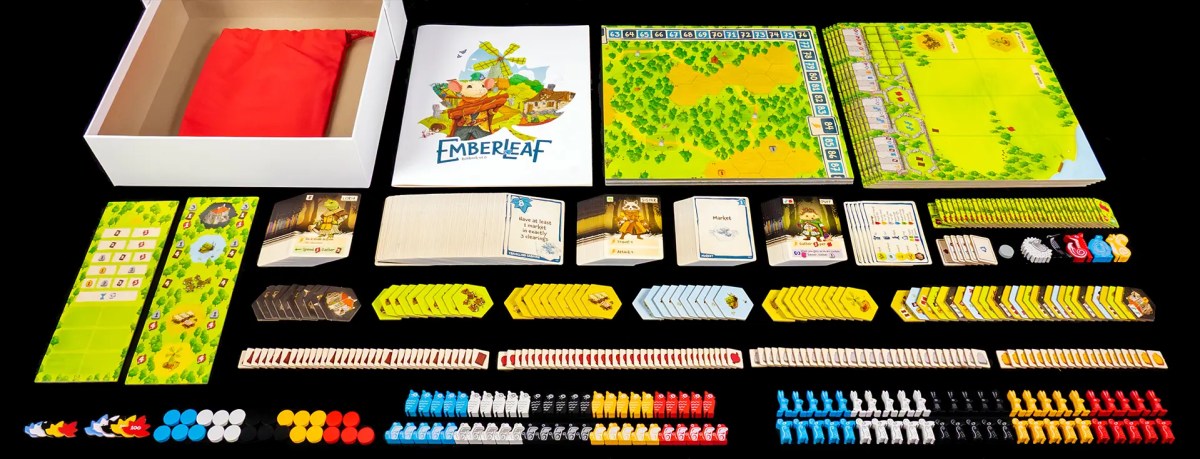
How to Play
Emberleaf is a design in which players attempt to develop their clan by playing cards onto their personal board or, alternatively, sliding them one position to the left (meaning any cards in the leftmost column will return to their hand). Additionally, players can charge cards with resources to resolve extra actions or promise favors if they are in a zone containing their colored disc (retrieving it). Through the actions granted by the cards, players will be able to move their hero between zones, gather resources, fight danger tiles, or construct buildings where they can house villagers to score points. Each time danger tiles are fought, players advance on the war banner track, which provides benefits and, upon reaching the final space of the track, a trophy. A trophy is also claimed upon filling the last space of a clearing with a building. The game ends when all trophies have been claimed, scoring points for completed favors.
Key Concepts
Let’s begin with the Main Board. It depicts a map with six clearings connected by paths. Each clearing features a series of hexagonal spaces where players will construct buildings. Beside each clearing is a campsite space where favor discs and player hero pawns are placed. These clearings are interconnected by a network of paths onto which danger tiles will be placed. Along the board’s border, we find a score track with spaces numbered from 0 to 99. Certain spaces feature bonus rewards that trigger for all players once the first player reaches or passes them.

The Hero Pawns represent each player on the main board of Emberleaf. These pawns begin at the Hawker’s Crossing clearing and move among the board’s six clearings using the “walk” ability, allowing players to interact with specific areas to gather resources, fight danger tiles, or construct buildings.

Players will need to stockpile Resources in order to construct buildings. There are four types of resources: wood, food, stone, and honey. These are acquired via the gather action (though they can also be earned through other avenues, such as bonuses) and stored on the player’s personal board, which sets an upper limit, requiring excess to be discarded if exceeded.

To execute actions, each player possesses a hand of Character Cards. Play begins with a starting hand of six cards that can be expanded by acquiring up to four additional hero cards. The anatomy of the cards is identical: a set of icons in the upper-left corner is referenced to resolve actions while the card remains in play, while the bottom strip features two effects. These effects show distinct background colors based on how they trigger: immediate (yellow), charge (red), passive (purple), slide (green), and leave the board (blue).

These cards are played onto the Community Board, which offers slots for up to 8 cards (6 starting, 2 unlockable). In the upper right corner, we find storage for resources (initially holding up to eight resources, with the capacity to expand to twelve). On certain spaces of the board, Community Buildings are placed with a resource cost printed directly on them; once constructed, these unlock permanent bonuses such as additional icons, card slots, or storage space. Finally, the top row contains slots for villagers, each offering a bonus that activates when placing that villager into a building on the main board.

One of the players’ primary goals is to construct buildings in the clearing spaces. In addition to the community buildings each player has on their personal board, players can construct Common Buildings. There are five types: houses, markets, boathouses, windmills, and town halls, each with a cost indicated on the Common Buildings Board.

Upon constructing a building, the player must place a Villager pawn on it. There are four types of villagers: rats, owls, rabbits, and frogs, with five pawns of each type. They are placed from left to right, triggering the bonus printed on the slot from which they are taken. Furthermore, placing a villager can establish a neighborhood if the player creates or extends a group of connected building tiles containing at least one of their villagers (certain card effects allow housing villagers in pre-existing buildings, making it possible to occupy buildings alongside other villagers).

A Favor Disc is placed in each clearing. These discs enable the “promise a favor” action whenever the player’s hero is present in the corresponding clearing, allowing them to take a favor card and remove the disc.

These Favor Cards represent end-game scoring objectives that players accumulate in their play area. During the game, five cards are displayed face up next to a draw deck, and players acquire them via the “promise a favor” action while in a clearing containing their favor disc (retrieving the disc in the process).

Another key element of the design is the set of Danger Tiles. These are placed along the paths of the main board, initially on their green side and later on their yellow side following a reset (the yellow side being more difficult). These tiles, featuring health values and victory points, block paths by increasing movement costs, and are cleared using the “attack” ability. When defeating them, players earn victory points and claim the tile as a war banner, in addition to advancing on the trophy track.

This track is located on the Trophy Board, where players advance a marker each time they remove a danger tile from the main board. With every step forward, the active player claims one of the available bonuses in the newly reached row. Upon reaching the end, the track resets and repopulates the board with fresh danger tiles. The lower section houses the supply of trophy tiles.

The 6 Trophy Tiles are awarded when completing clearings (claimed by the player who places the final building) or upon reaching the end of the war banner track (by the active player). These trophies provide an immediate benefit to the player who claims them (top row) and a secondary benefit to all other players. Claiming the sixth tile triggers the end of the game.

Lastly, the ultimate objective is to amass the most victory points. These points are tracked on the score track using the Score Markers. Over the course of the game, points are scored by placing villagers into neighborhoods, clearing danger tiles, winning trophies, or unlocking track bonuses. At the end of the game, players simply tally the points from their accumulated favor cards.

That is enough to get started.
Preparación de la Partida
- Place the main board in the center of the table.
- Set up the building board to one side. Place stacks of the various common building types onto it.
- Set the trophy board to the appropriate side based on player count, placing the disc on the starting space of the war banner track.
- Display the six trophy tiles on the trophy board.
- Shuffle the favor deck and place it face down beside the board. Then, reveal the top five cards in a display row.
- Shuffle the hero deck and place it face down beside the board. Next, reveal the top five cards in a display row.
- Place all danger tiles into the cloth bag. Draw one tile per danger space on the main board, placing them all green side up.
- Form a general supply with the resource tokens.
- In games with fewer than 4 players, place common buildings onto the designated spaces of the main board. For 1/2 players, take 3 buildings of each type (15 total) and distribute them randomly among the spaces marked 3+ and 4+. For 3 players, take 2 buildings of each type (10 total) and distribute them randomly among the spaces marked 4+.
- Each player chooses a color and receives:
- A community board placed in their play area.
- 6 Community buildings, placing one of each of the 6 distinct tiles into its matching space on their community board.
- 20 villagers placed on the reserve spaces of their community board.
- A community deck (all cards share the same letter on their reverse side).
- A Hero pawn, placed in the campsite at Hawker’s Crossing.
- 5 Favor discs, placed in the campsites of the other five clearings where their hero is not located.
- A score marker placed on space 0 of the score track.
- A 100+ token placed near space 0 of the score track.
- A reference card.
- Each player receives one honey token to place in their storage.
- Finally, choose a starting player at random.
We are ready to begin!

Game Flow
A game of Emberleaf is played over an indeterminate number of rounds. In each round, starting with the first player and proceeding clockwise, each player takes a turn.
On each turn, the active player completes five steps:
- Actions. The player must perform one main action (mandatory) and any number of optional actions, in any order.
- The Main Action can be:
- Play a card. Choose a hero card from your hand and place it into an empty space on your guild board. Resolve the card’s “when played” abilities or, alternatively, the space’s guild ability.
- Slide cards. Slide all cards on your guild board one space to the left. Resolve “slide” and “fall” abilities as appropriate; cards that fall off return to your hand.
- The Optional Actions are:
- Charge a Card. Spend resources to activate a “charge” ability on a hero card on your board, placing the spent resources onto the card. If a card already holds its maximum allowed resources, it cannot be activated this way again.
- Promise a Favor. If your hero is in a clearing that still contains one of your favor discs, choose a face-up favor card and retrieve your disc from that clearing.
- The Main Action can be:
- Trophies. Check whether any player has earned a trophy (by placing the final tile in a clearing or reaching the last space of the war banner track). Award trophies in turn order, resolving bonuses.
- War Banners. If the marker has reached the end of the track, return it to the start, put all danger tiles back into the bag, shake it, and repopulate the board with nine tiles placed on their yellow side.
- Score Track Bonuses. If the player is the first to reach or pass a bonus space on the score track, all players receive the bonus in turn order.
- Refill Supply Cards. If any market is missing at least one card (heroes or favors), discard the rightmost card, slide remaining cards to the right, and draw new cards from the respective deck until five are visible again.
When resolving your turn, keep in mind any passive effects active on character cards on your board.
After this, the turn passes to the player seated to the left.
The abilities shown on cards provide the following actions:
- Walk. For each movement point, the player can move their pawn to a directly connected clearing. If the path contains one or more danger tiles, an additional point must be spent for each of these tiles. The pawn is placed in the clearing’s campsite.
- Gather. The player takes the corresponding number of resources from the general supply according to the action. If a player exceeds their storage capacity, they must discard the surplus. The player chooses which resources to keep and which to discard.
- Attack. The player selects a danger tile situated on one of the paths connected to their hero’s current clearing (if there are multiple tiles on the path, the one closest to the clearing must be targeted), provided the player possesses at least as much attack power as the tile’s health value. The player removes the tile (placing it in their play area), scores the victory points printed on it, and advances the marker on the war banner track to the next row, choosing any available bonus from that row. Reaching the final row grants no immediate bonus (the reward is claimed in a later turn step). If the marker is already in the final row, nothing happens.
- Build. The player selects a building tile (either from their personal board or the common market), paying the required resource cost to the supply. Then, they place the tile onto an open space in the clearing where their hero is located. If the space features a reward, the player claims it immediately. Next, they must house a villager from their personal reserve on the new building (choosing the leftmost villager of any of the four types and immediately claiming its bonus). Additionally, if the player creates or expands a neighborhood (a group of interconnected building tiles containing at least one villager of their color), they score points equal to the number of distinct building types in that group (up to a maximum of five). Finally, if the player completed one or more clearings during their turn, they may claim one trophy per completed clearing during the appropriate phase.

Game End
The end of the game is triggered when the sixth trophy is awarded. The round is completed, and each player proceeds to score their favor cards, gaining points for any met requirements.
The player with the most victory points is declared the winner. In case of a tie, the following criteria are used:
- The player who has housed the most villagers.
- The player who has collected the most danger tiles.
If the tie persists, victory is shared.
Variants
Solo Mode. Setup follows a standard 2-player game. The player competes against their “sister,” an automated bot with its own deck of action and favor cards, aiming to beat her victory point total. The bot’s play area is configured with favor cards (scaled to difficulty: easy, medium, hard, very hard, ultimate), building cards (one face up, four face down), and an action deck. On each of the bot’s turns, its stamina is checked (summing icons on face-up action cards): if it is less than 5, it executes an action (travel, attack, build, discard hero/favor card, draw card, shuffle deck); if it is 5 or more, it rests (discards actions, reveals a building, scores reputation leaves). The bot does not use resources or house villagers, but scores victory points from trophies and buildings where villagers are housed.

Personal Opinion
As you already know, I am not particularly fond of games that hit the market on the back of massive crowdfunding campaigns. First of all, a massive funding haul often inflates expectations without anything substantial to support them.
Secondly, I am a staunch advocate for the role of the game developer, a figure traditionally tied to established publishers who is often sorely missed in projects relying on this release method. Great designs usually have one or several people behind them dedicated to polishing the core mechanisms. To be fair, some designers are capable of acting as a one-person orchestra and delivering fully fleshed-out designs to publishers on their own—Simone Luciani being a prime example.
That said, you never know when you might run into one of those exceptional creators. In this particular title, we have the involvement of Frank West, the mind behind games like The City of Kings and The Isle of Cats (read the tocho-review here). He certainly earned the benefit of the doubt, which is why I decided to pick up a copy of Emberleaf. Let’s see how it fares on the table.

In Emberleaf, we step into the shoes of an Emberling aiming to reclaim the land that once belonged to these creatures before falling under the yoke of Lord Vesh, who razed everything and left only ash in his wake. Consequently, we must not only fight off the remnants of this villain’s forces, but also rebuild the various settlements to shelter our refugees.
Mechanically, the game revolves around hand management with character cards that build up momentum. Each card offers effects that typically tie into the visible icons on your personal board, provided either by the characters themselves or through bonuses unlocked by constructing certain buildings.
When taking a turn, the active player has two options. On one hand, they can play a card from their hand and execute its immediate effects. Alternatively, they can take a slide turn, where every card on their player board shifts one space to the left, causing cards in the leftmost column to leave the board and return to hand.
Many card effects activate during this slide turn, making the placement of characters across your board—which features two rows of three slots (with the possibility of unlocking an extra slot per row)—crucial. Precise placement matters because sliding occurs sequentially to open up spaces for subsequent cards to move into.
Without careful planning, you might trigger an effect requiring specific resources before the card providing them further down or to the right has had a chance to slide. The same applies to effects that trigger when a card exits the board.

This activation engine represents the most intriguing aspect of the game, as it introduces a form of sequential programming. Rather than planning everything within a single turn, you build it out gradually, weaving together immediate effects upon playing cards with those triggered during slides.
What do we achieve with these actions? Essentially, we aim to build structures and attack enemy units to collect war banners, representing two of the primary scoring avenues. Attacking danger tiles awards victory points directly, alongside a bonus granted by advancing your disc along the war banner track.
This shared track might seem like a prime source of player interaction, encouraging opportunism as players try to capitalize on the disc’s position to trigger the next reward. However, this is one of the design elements that fell flat for me: it introduces a dynamic where players hesitate to attack, waiting for an opponent to push the marker forward instead—especially in the lower rows where rewards are less enticing.
Given that this track is a primary source of trophies, and trophies dictate game length, play time can drag out excessively. Granted, once you grasp how scoring works, you realize the priority is simply defeating as many danger tiles as possible, since many end-game favors reward accumulating these tiles.
The other path, naturally, is constructing buildings. Every time we build a structure, we must place a villager from one of the four tribes on our personal board into it. This action allows us to score victory points by forming connected groups of distinct building types containing our villagers.

It also triggers bonuses tied to the space from which the villager was removed. The first bonus for each villager type is particularly critical, as it allows adding a new hero card to your hand, introducing a light deck/hand-building element.
I appreciate that players can only add up to four cards to their hand; uncapped card acquisition would likely drag the game out even longer without offering much strategic advantage. The real fun lies in creating synergies within the constraint of four additional cards.
In some sessions, players might feel overly punished by RNG when drafting these cards, as none of the available options in the market may align with their setup. In reality, the cards do not differ drastically from one another; they all boil down to four basic actions: moving, gathering resources, attacking, or building. Ultimately, you need to do a bit of all four to secure a win.
As mentioned earlier, the board features six clearings where we build these structures to house our villagers. These clearings are linked by paths that allow our hero pawn to travel between them. The hero’s location defines where we can act, whether to construct buildings or attack danger tiles along adjacent paths.
To discourage players from camping in a single clearing, the game provides an incentive to travel across the board: favor discs. Aside from your starting clearing, every clearing holds a disc for each player, representing a favor waiting to be promised to the future inhabitants of that village.

These favors function as end-game scoring objective cards. Their scoring criteria revolve around villager types, building types, resources, or collected danger tiles. The deck is generous enough that, regardless of your strategy, you are likely to find cards that fit your engine.
Turns continue in this fashion until the game end is triggered by claiming the final trophy. This occurs either by reaching the end of the war banner track or by completing clearings—the other method allowing the player who places the final building to claim a trophy—followed by final scoring focused entirely on favor cards.
As you can see, the game is relatively straightforward with an accessible premise: gather resources to build structures, and move around to build in specific spots or engage nearby enemies. To be fair, the first play feels engaging; you stay entertained trying to optimize card placement and squeeze every last drop of value from your icons.
Unfortunately, these positive impressions fade quickly. Once you pass the thirty-minute mark with no end in sight, the gameplay begins to feel sluggish and repetitive. Primarily, this stems from the fact that the design offers very little room for true strategic growth.

Sure, you can recruit four new heroes to bolster your hand. However, once acquired, you are largely locked into running that exact combination on repeat. Cards will occupy slots on your board, and those placed further to the right require multiple turns to slide off and return to your hand, pushing you to maximize their presence while they remain on the board.
Turns spent simply playing a card are relatively quick. Conversely, once a player has six or more cards on their board, resolving a slide turn can bring the game’s pacing to a dead halt as they step through card effects one by one.
While satisfying in the opening rounds, repeating this process over multiple turns makes maintaining focus difficult during complex turns. This issue worsens significantly at higher player counts if several players take consecutive slide turns. You can easily spend ten minutes waiting around, to the point where you forget your own plans by the time your turn comes back around.
This brings me back to my opening remarks: Emberleaf clearly lacks sufficient development. The core ideas are not bad, but the playtime is excessive and lacks mechanisms to speed up the flow. Players often start rushing their turns just to inject momentum, but the damage is already done; the feeling of running through identical motions without meaningful progression becomes hard to shake.
Given its weight and premise, Emberleaf should be a much shorter experience. Mechanically, it evokes titles like Viscounts of the West Kingdom (read the tocho-review here) or Lewis & Clark (read the tocho-review here). However, those games offer a broad decision space, whereas Emberleaf funnels players into repeating the same loop: building and attacking via icon accumulation.

Another symptom of underdeveloped design is that most personal board upgrades require honey. Honey is difficult to acquire, available only by building on specific board spaces (leading to a rush toward those spots) or through the war banner track (running into the aforementioned hesitation issue).
This setup leaves the impression of a scripted opening. Most players default to the same early sequence: move to an open clearing, gather resources for a personal building requiring honey, build on a honey-granting space (to fuel the next upgrade), place a villager to unlock a new card, and claim a favor. If another honey space remains, repeat the process.
The strict resource cap creates another unnecessary bottleneck. While preventing runaway abundance makes sense, overly restricting storage in a game with limited actions prevents players from building at a satisfying pace. Allowing looser resource hoarding would have done wonders for game tempo.
Unsurprisingly, scalability suffers as a result. Because interaction is limited to claiming clearings, snatching market cards, or triggering track bonuses, the game is best played at two players to keep downtime low and minimize the sense of repetition.
Replayability also falls short. Despite the appearance of high variability with extensive decks of hero and favor cards, the cards feel largely interchangeable in practice. Combined with low player interaction, sessions tend to play out identically, causing the desire to bring it back to the table to drop sharply.

On the production side, there is little to complain about. The pre-painted wooden pieces feature distinct silhouettes and look great on the table. The cardboard components offer decent thickness and punch out cleanly. The cards feature good weight, excellent snap, and a nice linen finish (sleeving is hardly necessary since cards are rarely shuffled or held in hand for long). The rulebook is clearly organized and leaves no ambiguities.
Visually, the aesthetic is appealing. I like the minimalist cover art that follows the style of The Isle of Cats, using clean white space behind a centered illustration. The cards have personality, though their serious tone feels slightly at odds with the gameplay. The main board and buildings are colorful, although using nearly identical color tones for windmills and markets is an oversight that can cause confusion during favor scoring. A distinct red or purple would have solved this easily.
And let’s wrap this up. Emberleaf promised an engaging experience with its rebuilding theme and card-sliding engine, but falls short in execution. The card placement and movement mechanics, while clever at first, quickly turn repetitive and lack strategic depth, stretching playtime unnecessarily and inducing stagnation. It has interesting ideas, but the lack of thorough development becomes apparent early on, diminishing the urge to play with each subsequent session. It teeters on the edge, but I will give it a…
